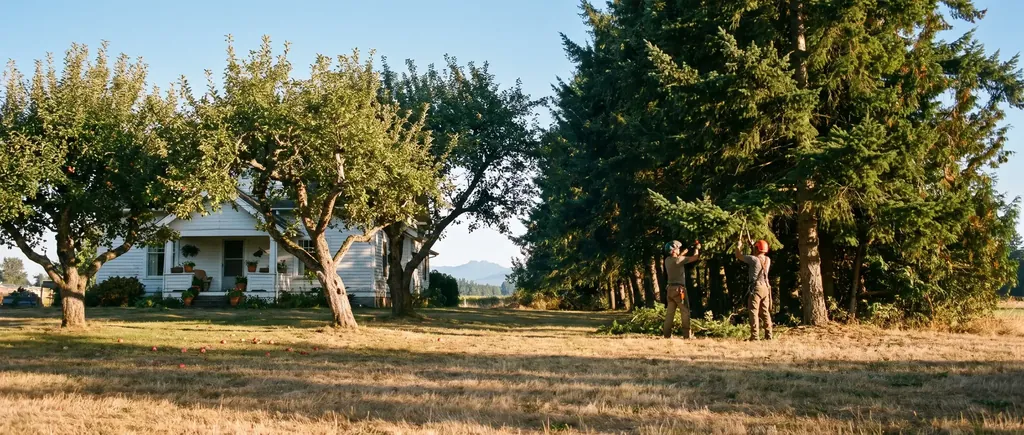
Old orchard trees and a windbreak beside a Lynden farmhouse

Tree Trimming in Lynden, WA

Old orchard trees, windbreak rows and big yard conifers pruned for the open farm country and the wind that comes with it.

  • Free on-site estimates
  • Every cut explained before we make it
  • No topping, ever
  • Long farm drives are normal for us

Farm country trees take the weather head on

Lynden is surrounded by farmland: raspberry and blueberry fields, dairies, and long flat stretches running up to the Canadian border. Trees out here were mostly planted with a job to do. Windbreak rows along the edges of fields and yards. A few fruit trees behind the farmhouse. A pair of big conifers planted for shade and shelter a long time ago that now tower over the house and the shop.

Plenty of those trees are still doing their job, and plenty of them have gone a long time without anyone pruning them. The old apples and pears have turned into thickets of water sprouts that fruit poorly. The windbreaks have dead, broken tops and gaps where a tree came down. The yard firs and spruces have grown long, heavy limbs out over the roof.

What makes Lynden different from Bellingham is exposure. On open ground near the border, nothing stands between your trees and the cold northeast outflow winds that pour out of the Fraser Valley in winter. A tree that would be sheltered in town takes the full force here, often on ground that is soft and wet at the same time.

In town, around the older streets and the parks, the work looks more like Bellingham's: established maples and conifers close to houses. Big old trees like the ones in Berthusen Park are a good picture of what a conifer here can become with room and time, and a reminder of why most of them are worth keeping.

Tree work we do in Lynden

Fruit tree pruning for old orchard and farmhouse trees, including restoring neglected ones over a few dormant seasons rather than all at once.

Tree trimming and pruning for windbreak rows and big yard conifers, with deadwood and broken tops out and long limbs over buildings reduced.

Hedge trimming for the laurel and arborvitae screens around homes and along roads.

Storm tree work after an outflow event or a windstorm, and tree removal for windbreak trees that are dead or failing.

Stump grinding and land clearing on farm properties and acreage.

What is different about trimming trees in Lynden

Wind from the northeast

Many of the windstorms that hit the county blow in from the south. In Lynden, the cold outflow from the Fraser Valley comes from the opposite direction, so the same trees get pushed from both sides over a winter. We look at which way your trees take the wind before deciding what to cut.

Windbreaks are a system

Taking one tree out of a windbreak changes the load on the trees either side of it. We prune and remove windbreak trees with the whole row in mind, so the shelter keeps working.

Old fruit trees can come back

A neglected apple that has not been pruned in twenty years usually is not finished. It needs the dead and crossing wood out, the water sprouts thinned, and the height brought down over two or three winters. Doing it all in one season usually triggers a forest of water sprouts and sets the tree back for years.

Farm and critical area rules

Trees along streams, ditches and wetlands on farm ground can carry extra rules about clearing and cutting. If the trees are near water, check with the City of Lynden or Whatcom County before major removal.

Lynden tree trimming questions

When to trim trees in Washington state?

For most deciduous trees on this side of the mountains, the dormant season works, and late winter before the buds break is the best part of it. You can see the structure with the leaves off, and the tree has the whole spring to close its wounds. Fruit trees should wait until late winter, apart from cherries, which are better pruned in dry weather in late summer. Conifers can be pruned through most of the year. Dead, broken or dangerous limbs should come out whenever you notice them.

How many branches can you cut off a tree without killing it?

It is less about the number of branches than the share of live foliage. A common rule of thumb is to remove no more than about a quarter of the live crown in one season, and less on an old or stressed tree. Several small cuts are far kinder than one huge one. Topping, which removes most of the crown at once, is the classic way to do lasting harm.

Can you cut down trees on your own property in Washington state?

Often, yes, but not always. Trees near streams, wetlands, steep slopes or shorelines, and trees on property with covenants, can carry restrictions. Check with your city or with Whatcom County before a removal, especially on farm ground near water.

Who pays to cut overhanging tree branches?

In general, a neighbour may trim branches that hang over the property line back to that line, at their own cost, as long as the cut does not damage or kill the tree. Washington has specific law on damaging a neighbour's tree, so talk to the owner first and confirm your rights before cutting anything substantial.

Nearby

We also trim and prune trees in Bellingham, Ferndale and Blaine, and in Everson, Sumas, Custer, Birch Bay, Deming and Sudden Valley.

Areas we serve

Get a free tree trimming estimate in Lynden

Tell us the address and which trees you are worried about. A photo helps. We will come out, look at them with you, and give you a written price.

Needles in the gutters, a limb over the roof, a view closing in. Tell us in your own words.

Free and no obligation. Prefer to talk? Call (360) 555-0137.