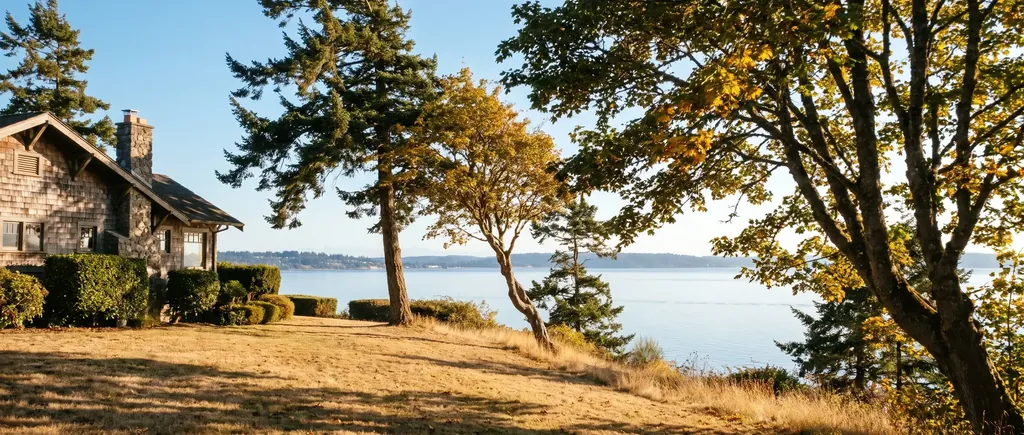
Shoreline trees above the water near Blaine

Tree Trimming in Blaine, WA

Shoreline trees pruned to stand up to the wind, and water views opened without stripping the lot bare. Blaine, Birch Bay and Semiahmoo.

  • Free on-site estimates
  • Every cut explained before we make it
  • No topping, ever
  • View pruning done in stages

On the water, the wind and the view decide the cuts

Blaine sits right on the border, at the top of the county, with the Peace Arch at one end of town and water on almost every side. Drayton Harbor wraps around behind Semiahmoo Spit, and Birch Bay curves away to the south. A lot of the homes here were bought for what you can see from the deck, and a lot of the trees here spend the winter taking wind straight off the water.

Those two facts pull in opposite directions. Owners want the trees lower and thinner so the view comes back. The trees need their structure, and on an exposed shoreline lot a tree that has been cut badly is a tree that comes down in the next blow. Topping a shoreline fir to clear a view is the worst of both: it grows back as a dense cluster of weakly attached leaders, and the view closes up again within a few seasons.

The work that holds up here is selective. Thinning a crown lightly and shortening its longest, heaviest limbs. Windowing a tree, removing chosen limbs so you see the water through it rather than over it. Raising the lower branches to open the sightline under the canopy. Done in stages over a few seasons, that keeps both the tree and the view.

Around Semiahmoo and in the newer neighbourhoods, much of the work is ornamental trees and hedges planted close to houses. In Birch Bay, it is tight cottage lots where laurel, holly and conifers crowd decks, roofs and the line of sight to the bay.

Tree work we do in Blaine and Birch Bay

View pruning to open views of Drayton Harbor, Semiahmoo Bay and Birch Bay by thinning, windowing and crown raising.

Tree trimming and pruning for wind-exposed conifers and broadleaf trees, with deadwood out, crowded growth thinned lightly, and long, heavy limbs shortened so the crown carries less weight at the ends.

Hedge trimming for laurel, holly and arborvitae on tight shoreline lots.

Storm tree work after winter windstorms, and tree removal when a shoreline tree is failing or leaning toward the house.

Stump grinding after a removal, and blackberry removal on overgrown banks and lot edges.

What is different about trimming trees in Blaine

Wind off the water

Shoreline trees take wind with nothing in the way, from the south in the Pacific storms and from the northeast when cold air drains out of the Fraser Valley. A tree with its dead wood out and its longest limbs shortened is far better placed than one that has been topped or stripped out inside.

Views are opened slowly

Taking too much from a tree in one go to clear a view shocks it and triggers a burst of new growth that closes the gap again. Opening a view a stage at a time, over two or three seasons, gives a longer-lasting result and a healthier tree.

Salt and exposure

Trees on the water deal with salt spray and constant wind, which can brown foliage. We cut lighter on the most exposed trees and leave them the leaves they need.

Shoreline rules

Trees and vegetation close to the shoreline can carry extra rules, and some neighbourhoods have covenants about trees and views. If your lot is on or near the water, check with the City of Blaine or Whatcom County, and with your homeowners association, before heavy pruning or removal.

Blaine tree trimming questions

What is Blaine Washington famous for?

The Peace Arch and the border crossing between Washington and British Columbia, Semiahmoo Spit and its resort, and the shoreline along Drayton Harbor and Birch Bay. For anyone living here, it is also known for big water views and for wind.

Which trees should not be planted close to a house?

Large, fast-growing trees with weak wood or aggressive roots. Around here that means cottonwood, alder, willow and big-leaf maple, plus Douglas fir and other big conifers that will be well over a hundred feet tall given time. On a shoreline lot, anything that will grow into the view is worth thinking twice about as well.

What is the 10/20/30 rule for trees?

It is a guideline for planting a varied, resilient mix of trees across a street, a neighbourhood or a town: no more than 10 percent of any one species, 20 percent of any one genus, and 30 percent of any one family. The idea is that one pest or disease cannot wipe out most of the canopy at once. It is a planning rule rather than a pruning one.

How to identify trees in Washington state?

Start with the needles or leaves. Douglas fir has soft needles and cones with three-pointed bracts poking out between the scales. Western red cedar has flat, scale-like sprays and stringy red bark. Big-leaf maple has the largest leaves of any maple you will see here. Red alder has smooth grey bark, often blotched white with lichen. A regional field guide covers the rest.

Nearby

We also trim and prune trees in Bellingham, Ferndale and Lynden, and in Birch Bay, Custer, Sumas, Everson, Deming and Sudden Valley.

Areas we serve

Get a free tree trimming estimate in Blaine

Tell us the address, which trees you are thinking about, and what you would like to see from the house. A photo from the deck helps. We will come out and give you a written price.

Needles in the gutters, a limb over the roof, a view closing in. Tell us in your own words.

Free and no obligation. Prefer to talk? Call (360) 555-0137.