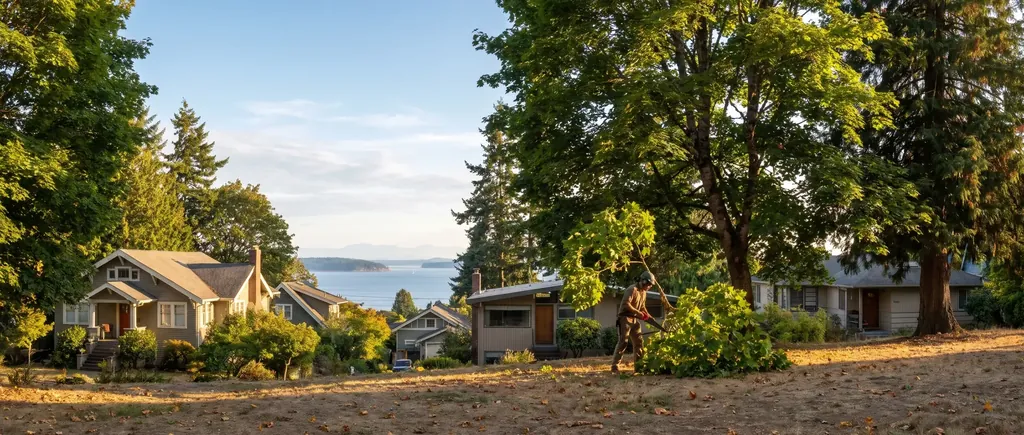
Leafy Bellingham neighbourhood above the bay

Tree Trimming in Bellingham

Big firs, cedars and maples pruned to live alongside the house, and hillside views opened without losing the trees.

  • Free on-site estimates
  • Every cut explained before we make it
  • No topping, ever
  • Heavy limbs lowered on ropes over roofs

Bellingham grew up under big trees

Walk any of the older Bellingham neighbourhoods and the trees are the first thing you notice. In Edgemoor, South Hill, Columbia and Fairhaven, Douglas firs, western red cedars and big-leaf maples that were planted or spared generations ago now stand taller than the houses beside them, often a few feet from the eaves. Around Sehome Hill and down along Chuckanut, lots back straight onto native forest.

Those trees are a large part of why people want to live here, and they are also why so many Bellingham calls start the same way: needles and moss filling the gutters every winter, a maple limb lying on the roof, a cedar rubbing the service drop, a fir that leans a little more over the house than it used to. Almost all of that is fixable with careful pruning.

The other Bellingham job is views. Hillside homes in Edgemoor, South Hill and above Fairhaven were often bought for a look out over Bellingham Bay and the San Juan Islands, and the trees downhill have been growing into that view ever since. Opening it back up is pruning work, done by thinning and windowing a crown so you see through the tree, not by cutting the top off it.

Further north in Barkley and Cordata, the trees are younger and the lots are newer, and the work is more often hedges, ornamental maples and the conifers left standing when the houses went in. Out around Silver Beach and the north shore of Lake Whatcom, it is steep wooded lots with big trees close to the water and close to the house.
Tree work we do in Bellingham

Tree trimming and pruning for the big conifers and maples over roofs, decks and driveways, with deadwood out, crowded growth thinned lightly, and long, heavy limbs shortened so the crown carries less weight at the ends.

View pruning on hillside lots facing the bay and the islands, opening the view in stages the tree can tolerate.

Hedge trimming for the laurel and arborvitae screens that run along so many Bellingham property lines.

Fruit tree pruning for the old backyard apples and plums in the established neighbourhoods.

Tree removal, done in sections on tight city lots, when a tree is dead, failing or genuinely too big for where it stands.

Storm tree work after a winter blow, and stump grinding when a tree has come out.

What is different about trimming trees in Bellingham

The trees are close to the houses

On most Bellingham lots there is nowhere to drop a limb. Heavy wood gets cut in pieces and lowered on ropes over roofs, gardens and fences, which takes longer and is why the job is priced on the tree in front of us, not on its height alone.

Gutters, moss and roofs

Conifers over a roof drop needles year round, and a shaded roof in this climate grows moss. Raising and thinning the crown over the house lets light and air reach the roof and cuts down how much ends up in the gutters, without taking the tree away.

Windstorms find weak crowns

Bellingham gets hard winter winds off the water and down from the north. Dead wood and long, heavy limbs over the house are what usually fail. Removing dead wood and reducing end weight are the most useful things you can do for a big tree before the storm season.

City tree rules

Some Bellingham properties, including lots near streams, steep slopes, shorelines and the Lake Whatcom watershed, can carry extra rules about cutting trees. Check with the City of Bellingham before any removal or heavy pruning on a lot like that, and we will help you work out what to ask.

Bellingham tree trimming questions

What are the most common trees in Western Washington?

Douglas fir, western red cedar and western hemlock among the conifers, and big-leaf maple, red alder and black cottonwood among the broadleaf trees. In Bellingham yards you also see a lot of planted ornamentals, fruit trees and English laurel hedges. Each one prunes differently, which is why we name the tree before we talk about the cuts.

Can I just cut branches off a tree?

You can, but where and how you cut decides whether the tree can seal the wound. Cut just outside the branch collar, the slightly swollen ring where the branch meets the trunk, rather than flush against the trunk or leaving a stub. Take heavy limbs in three cuts so the bark does not tear. And keep it modest: removing a large share of the live crown in one go stresses the tree and usually triggers a flush of weak sprouts.

What is the cheapest time of year for tree removal?

The tree and the access set the price far more than the calendar does. That said, late fall through winter outside of storm clean-ups is usually the easiest time to schedule, and broadleaf trees with no leaves on are lighter to handle. Booking ahead rather than the week after a windstorm also helps.

How much does it cost to remove a tree in Washington state?

It depends on the size of the tree, how close it is to the house or lines, whether it can be felled or has to come down in sections, and whether you want the stump ground and the wood hauled. On a tight Bellingham lot, sectional removal is the norm. We price after seeing the tree, and the estimate is free.

Nearby

We also trim and prune trees in Ferndale, Lynden and Blaine, and in Sudden Valley, Everson, Birch Bay, Sumas, Deming and Custer.

Areas we serve

Get a free tree trimming estimate in Bellingham

Send the address and a line about what the tree is up to. A photo helps. We will come out, look at it with you, and give you a written price.

Needles in the gutters, a limb over the roof, a view closing in. Tell us in your own words.

Free and no obligation. Prefer to talk? Call (360) 555-0137.