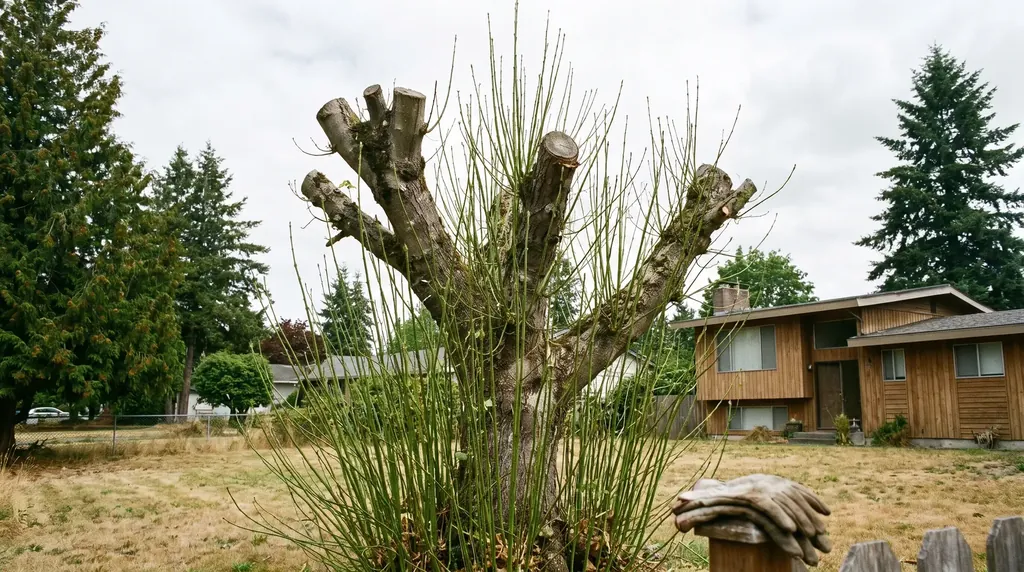
Why Topping a Tree Does More Harm Than Good
- Free on-site estimates
- Every cut explained before we make it
- No topping, ever
- Yard raked and cleaned before we leave
Topping means cutting the top of a tree off, or cutting big limbs back to stubs, to make it shorter. People do it to make a tree safer or to get a view back. It achieves neither for long. A topped tree regrows fast, the new growth is weakly attached, the stubs decay, and within a few years the tree is as tall as it was and more likely to drop limbs than before.
We do not top trees. Here is why, and what works instead.
Is topping a tree a good idea?
No, and the reasons are about how trees grow, not taste.
The regrowth is weak
When a tree loses its top, it pushes out a mass of fast shoots from buds just under each cut. These shoots grow from the outer layers of the stub, not from deep in the wood the way a normal branch does, so they are only loosely anchored. As they get heavy, they tear out in wind. In a place with winter windstorms and Fraser Valley outflow, that matters.
The stubs rot
A big cut made in the middle of a limb, away from any branch collar, leaves a wound the tree has no good way to seal. Decay gets in and works down into the trunk. Years later you have heavy regrowth sitting on top of rotten wood.
The tree is stressed and exposed
Topping can remove a huge share of the leaves in one day. The tree has to burn stored energy to replace them, which leaves it weaker against pests and disease. Bark that was shaded by the crown is suddenly in full sun and can scald and crack, particularly on thin barked trees like maples.
It costs more over time
The regrowth comes back fast and dense, so a topped tree needs cutting again every few years, and each round is harder and more hazardous than the last.
What does tree topping look like?
A topped tree has a flat or blunt top where a point or a rounded crown used to be. The limbs end in thick stubs, and from each stub comes a dense broom of thin, upright shoots. On a conifer, a topped leader is often replaced by several new leaders competing with each other, which gives the tree a forked, candelabra top. Once you know the shape, you will see it all over town.
Can a tree recover from topping?
Some can, partly, with years of corrective pruning. Over several visits the strongest new shoots are selected and the rest are removed, so the tree slowly rebuilds a proper structure. A tree with a lot of decay at the stubs may never be sound again, and some topped trees end up being removed. Firs and cedars that lose their leader do not recover their original form at all.
What is the difference between tree pruning and tree topping?
Good pruning cuts a branch back to where it joins a larger branch or the trunk, at a point where the tree can seal the wound and the remaining branch can take over. Topping cuts wherever it happens to make the tree the right height, with no regard for where the branches join.
There are two proper ways to make a tree smaller or let more light through:
- Crown reduction. Long limbs are shortened by cutting each one back to a lateral branch big enough to take over as the new end. The tree comes down in height and spread but keeps its natural shape. It suits broadleaf trees like maples and fruit trees, and only works to a point.
- Crown thinning. Selected branches are removed throughout the crown so light passes through and the crown carries less weight. The tree stays the same height and blocks less view. Done lightly, this is often the right answer for big conifers.
For views, windowing (removing a few branches to frame a view through the tree) often works better than trying to lower the whole tree.
What part of a tree should not be cut?
Avoid cutting into the branch collar at the base of a branch, avoid cutting the main leader of a conifer, and avoid cutting large limbs back to stubs. Those three cuts do most of the long term damage we see.
Sometimes the honest answer is that the tree is too big for where it is. A Douglas fir planted ten feet from the house will want to grow far taller than anyone will be comfortable with, and no amount of pruning changes that. When that is the case, removing the tree and planting something suited to the spot is often kinder and cheaper than topping it every few years.
Topping questions people ask
Can I top a tree without killing it?
Often the tree survives topping, at least for a while. Surviving is not the same as being healthy. It is left with weak regrowth, decaying stubs and a shorter life, and it will need more work, not less.
Will a tree grow back if you cut all the branches off?
Many broadleaf trees will throw out new shoots, but the regrowth is weakly attached and the tree is badly stressed. Most conifers will not regrow from bare trunk at all. Taking every branch off is close to a removal that has not finished yet.
Which trees should not be planted close to a house?
Trees that get very tall or have brittle wood: Douglas fir, western red cedar, big-leaf maple, cottonwood and red alder are common examples around here. Pick a tree whose mature size fits the space so it never needs topping.
Want a tree smaller without topping it?
Tell us what you are trying to fix, whether that is height, shade or a lost view. We will show you what reduction or thinning can do and be honest about where its limits are.
- Call(360) 555-0137
- Emailoffice@bellinghamtreetrimming.com
- HoursMon to Fri, 7:30am to 5pm. Saturdays by appointment.
Thanks, we have your request
We will be in touch to set up a time to look at the tree. If it is urgent, call (360) 555-0137.
Online requests are not switched on yet
Nothing was sent. Please call (360) 555-0137 and we will set up your free estimate.