How Much of a Tree Can You Cut Without Killing It?
- Free on-site estimates
- Every cut explained before we make it
- No topping, ever
- Yard raked and cleaned before we leave
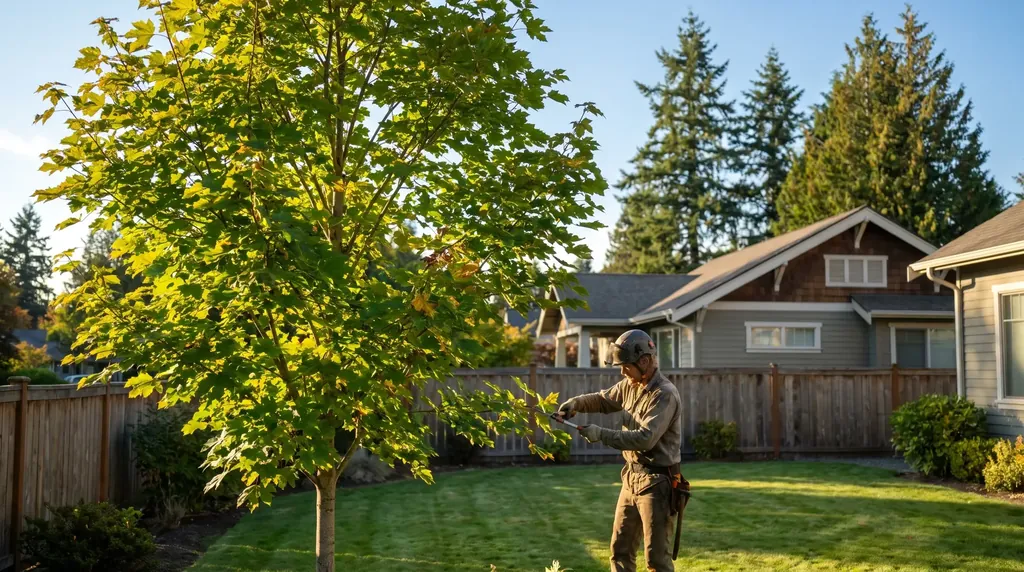
For a healthy tree, the widely used rule of thumb is to take off no more than about a quarter of the live crown in one growing season, and less than that on a big, mature tree. Count leaves and needles, not branches. Ten small twiggy branches can matter less than one big limb, because what the tree loses is its ability to make food.
That number is general horticultural guidance, not a law, and it is a ceiling rather than a target. Most good pruning removes far less. How the cuts are made matters as much as how many there are.
How much can you cut off a tree without killing it?
A tree runs on its leaves. Every branch you remove takes away some of the tree’s food supply, and the tree then spends stored energy sealing the wounds and replacing what it lost. A young, vigorous tree can absorb that. An old Douglas fir or a big-leaf maple that has been growing over the same roof for sixty years has far less in reserve.
So the quarter figure shrinks as the tree ages. On a mature tree, ten to fifteen percent of the live crown in a season is often plenty, and a stressed tree (one with root damage from construction, a crown already thinning at the top, or a lot of dieback) may need even less. If more needs to come off than that, spread the work over two or three years.
What usually kills a tree is not one heavy pruning. It is a heavy pruning on a tree that was already struggling, followed by a dry summer, followed by decay setting in at the big wounds. That is why the size of the cuts matters as much as the total.
Big cuts cost more than many small ones
A branch the thickness of your thumb seals over quickly. A limb the size of your thigh may never fully close, and the exposed wood is an open door for decay. Ten small cuts spread around the crown are almost always better for the tree than one large one, even when they remove the same amount of foliage.
Conifers are less forgiving
Most of our big conifers, fir and cedar especially, do not resprout from bare wood the way a maple or an apple will. Cut a fir limb back to a bare stub and that stub stays bare. Thinning and clearing conifers is about removing whole branches at the trunk, cleanly, not shortening them.
Can I just cut branches off a tree?
Yes, as long as you cut in the right place. Where the cut goes decides whether the tree seals it or rots behind it.
Look at the base of any branch and you will see a slightly swollen ring where it joins the trunk. That is the branch collar, and it holds the tissue the tree uses to close the wound. The cut goes just outside the collar, angled slightly away from the trunk.
Two cuts to avoid:
- Flush cuts. Cutting tight against the trunk takes the collar with it. The wound is bigger and the tree has nothing to seal it with.
- Stubs. Leaving a few inches of branch sticking out gives the tree nothing to grow over. The stub dies back and decay follows it into the trunk.
Heavy limbs need three cuts
A heavy limb cut in one go will tear as it falls and strip bark down the trunk. The standard approach is three cuts. The first is an undercut a foot or so out from the trunk, part way through. The second is a top cut a little further out, which drops the weight cleanly. The third removes the stub at the collar.
If the limb is over a roof, a power line or anything you care about, or you need to be off the ground to reach it, that is the point to stop and call someone with rigging gear.
What is the 1-2-3 rule for pruning trees?
There is no single agreed definition, and different sources use the name for different things. The most common meaning is an order of work: first remove anything dead, damaged or diseased, then remove branches that cross or rub, then prune for shape and spacing. Some people use the name for the three cut method on heavy limbs. Both are sound practice. If someone quotes the rule at you, ask which one they mean.
What is the 10/20/30 rule for trees?
In tree care this usually refers to planting diversity, not pruning. The idea is that a neighbourhood or city should have no more than ten percent of any one species, twenty percent of any one genus and thirty percent of any one family, so a single pest or disease cannot wipe out the canopy. It is a planning guideline for street trees and urban forests. It does not tell you how much to cut off a tree in your yard, and you may see the same numbers used loosely for other things.
Pruning questions people ask
How many branches can you cut off a tree before it dies?
There is no branch count, because branches vary so much in size. Think in terms of live foliage instead. Taking off more than about a quarter of the live crown in one season starts to put a healthy tree at real risk, and an older or stressed tree is at risk well before that.
Can I trim tree branches without killing the tree?
Yes. Normal pruning done in the right place and in sensible amounts does not kill trees. Cut just outside the branch collar, avoid stubs and flush cuts, keep cuts small where you can, and do not remove too much at once.
Is it okay to leave dead branches on a tree?
Small dead twigs inside the crown are normal and harmless. Dead limbs of any size over a roof, a path or a parking spot are a different matter. They get brittle, they come down in wind, and taking them out is one of the few cuts that does the tree no harm at all.
Does a tree feel pain when it's cut down?
Trees do not have a nervous system, so they do not feel pain the way animals do. They do respond to wounds by sealing them off, and every cut costs the tree energy. That is the real reason to prune carefully.
Not sure how much should come off?
Send us a photo of the tree and tell us what is bothering you. We will come out, look at it with you, and give you a straight answer and a free estimate.
- Call(360) 555-0137
- Emailoffice@bellinghamtreetrimming.com
- HoursMon to Fri, 7:30am to 5pm. Saturdays by appointment.
Thanks, we have your request
We will be in touch to set up a time to look at the tree. If it is urgent, call (360) 555-0137.
Online requests are not switched on yet
Nothing was sent. Please call (360) 555-0137 and we will set up your free estimate.