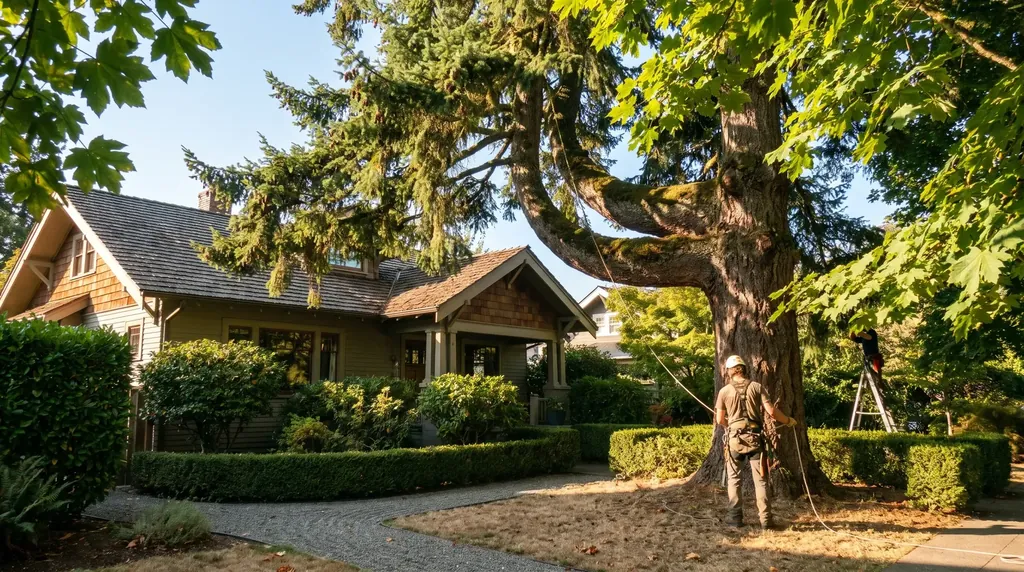
Is It Cheaper to Trim a Tree or Cut It Down?
- Free on-site estimates
- Every cut explained before we make it
- No topping, ever
- Yard raked and cleaned before we leave
For the same tree on the same day, trimming almost always costs less than removal. Removal means taking down the whole tree, usually in sections, then dealing with the wood and often the stump. Trimming takes off a fraction of that.
Over ten or twenty years the answer can flip. A fast growing tree in the wrong spot may need trimming every few years for the rest of its life, and those visits add up. The honest question is not which costs less this year, but which costs less for as long as you own the house, and whether trimming can actually fix the problem.
Is it cheaper to have a tree cut down or trimmed?
Start with what is wrong. If the issue is a few limbs over the roof, deadwood in the crown, or a tree that has simply grown too dense, trimming fixes it and the tree goes on giving you shade, privacy and value. That is the cheaper option today and usually the cheaper option over time too.
If the issue is the tree itself (it is dying, it is leaning toward the house, its roots are lifting the foundation, or it is a species that will always outgrow the space), trimming only buys time. You pay for it now, and you pay for removal later anyway.
Why is tree trimming so expensive?
Tree work is skilled, physical, slow and dangerous, and most of the cost is in time and equipment. The same factors drive trimming and removal prices:
Size and height
A tall Douglas fir needs climbing or a lift, and every cut takes longer at height. A small ornamental tree can often be done from the ground in a fraction of the time.
What is underneath it
A tree in an open field can have limbs dropped freely. A tree over a roof, a deck, a fence or a power drop means every piece is roped down. Rigging is often the single biggest factor in the price.
Access
A tree a truck can reach is quicker than one at the bottom of a steep backyard where everything has to be carried out by hand. Hillside lots in Bellingham and wooded lots around Sudden Valley are common examples.
Condition of the tree
Dead or decayed wood is less predictable to climb and cut. A tree with a lot of rot needs more care and sometimes different equipment.
Cleanup and stump
Chipping, hauling wood away and grinding the stump each add to a removal. Leaving the wood in rounds for firewood or the chips as mulch can bring it down.
What keeping a tree costs over time
Removal is a one time cost. Keeping a tree is a recurring one, and it is worth adding up honestly before you decide.
A healthy big-leaf maple or a Douglas fir that is well placed might need a check and a light prune every several years, which is a modest, predictable cost for a tree that shades the house and holds the hillside. A red alder or a cottonwood planted too close to a house is a different story. They grow fast, they drop limbs, and they may need work every couple of years for as long as they stand.
Things to weigh on the keep side: shade that keeps the house cooler in summer, privacy, a screen from the road or the neighbours, slope stability, and the fact that a mature tree cannot be replaced in your lifetime. On the remove side: repeated trimming, moss and needles in the gutters, roof cleaning, and the risk of a limb coming down in the next windstorm.
When should you not cut down trees?
There are cases where removal is the only real fix, and we will tell you so:
- The tree is dead or most of the crown has died back
- There is serious decay in the trunk or at the root flare
- A large crack or a weak split runs through the main union
- The tree has started to lean, or the root plate is lifting
- The species will always outgrow the spot no matter how often it is cut
And there are cases where you should not cut it down, or at least not yet: when it is healthy and the problem is a few limbs, when it is protected under local rules, or when it is holding a steep slope where removal could cause erosion.
Some trees need permission before they can be removed, particularly near water, on steep slopes or in protected areas. Check with the city or county before any removal, and we will help you work out what to ask.
Cost questions people ask
How much to cut down a 30ft tree?
It depends far more on what is around the tree than on its height. A 30 foot tree in an open yard is a fairly quick job. The same tree over a roof and a power drop, with no truck access, takes much longer. We give a firm price after seeing it.
Will insurance pay for tree removal?
Sometimes. Homeowner policies often cover removal when a tree falls on a covered structure, and often do not cover removing a healthy or dead tree that has not fallen. Coverage varies a lot between policies, so check yours or call your agent before assuming either way.
How to get a tree cut down for cheap?
Keep the wood as firewood, keep the chips as mulch, leave the stump if it is not in the way, and book outside storm season when crews are less stretched. Combining several trees or jobs in one visit also helps.
What is the best month to cut down a tree?
For most removals, late autumn through winter, once leaves are down and before birds start nesting. The ground can be soft in our winters, so access matters as much as timing.
Trim it or take it down?
Tell us about the tree and what is bothering you. We will come out, give you an honest answer on whether it can be saved, and price the options.
- Call(360) 555-0137
- Emailoffice@bellinghamtreetrimming.com
- HoursMon to Fri, 7:30am to 5pm. Saturdays by appointment.
Thanks, we have your request
We will be in touch to set up a time to look at the tree. If it is urgent, call (360) 555-0137.
Online requests are not switched on yet
Nothing was sent. Please call (360) 555-0137 and we will set up your free estimate.