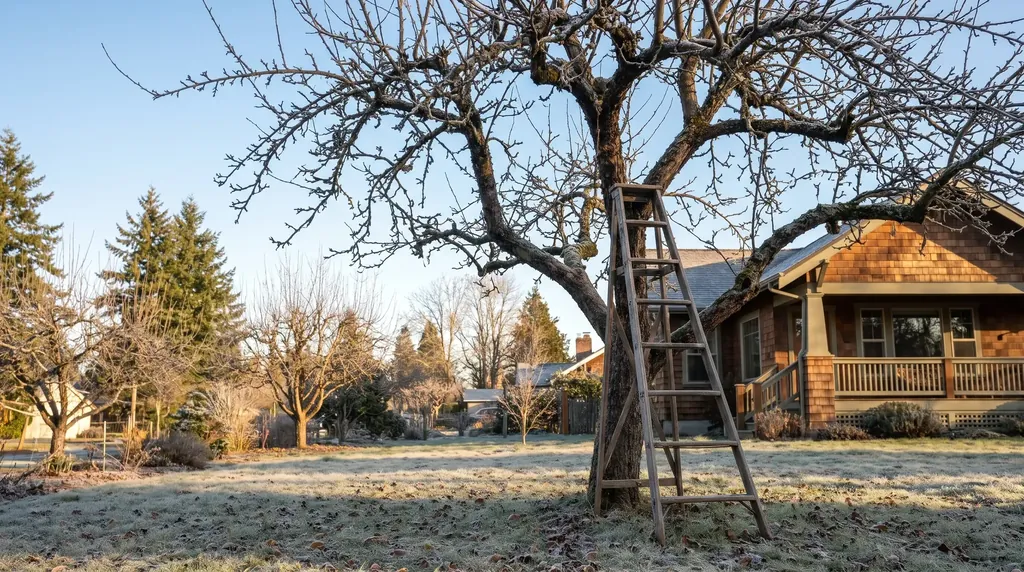
When to Prune Apple Trees in the Pacific Northwest
- Free on-site estimates
- Every cut explained before we make it
- No topping, ever
- Yard raked and cleaned before we leave
Prune apple trees in late winter, while they are still dormant and before the buds break. In Whatcom County that usually means February into early March, though a cold year in Lynden can push it later and a mild one in Fairhaven can bring bud break forward. The structural cuts happen then. A second, lighter round in summer deals with the water sprouts that shoot straight up after a winter prune.
That is the short answer. The rest is about which cuts belong in which season, how much an apple tree can take, and what our wet climate changes.
What month is best to prune apple trees?
February is the safest bet for most of the county, with early March close behind. Three things make late winter the right time.
First, the tree is dormant. Its energy is stored in the roots and trunk, so cuts made now cost it less than cuts made while it is actively growing. Second, the leaves are off, so you can see the whole structure: the crossing branches, the crowded centre, the limbs heading the wrong way. Third, the worst of the hard freezes are usually past, so fresh cuts are less likely to be damaged by cold.
Watch the buds rather than the calendar. Once they start to swell and show green at the tips, the window is closing. Light cuts are still fine for a few weeks after that, but big structural work is best saved for next winter.
How much can you cut an apple tree back?
On a healthy, well kept tree, a typical dormant prune takes out somewhere around a fifth to a quarter of the wood. More than that and the tree tends to answer with a flush of water sprouts, which crowd the canopy and give you more work next year, not less.
Cuts are made in a rough order of priority:
- Dead, broken and diseased wood first
- Branches that cross, rub or grow back into the centre
- Water sprouts and suckers from the base
- Thinning to open the canopy so light and air reach the inside
- Shortening long limbs that will sag under a crop
Open, airy canopies matter more here than in drier places. A dense apple tree in our climate stays wet for days after every rain, and wet leaves and bark are where fungal problems start.
Bringing back a neglected tree
Plenty of homes in Whatcom County, especially on older lots in Bellingham and out on farm ground around Lynden and Everson, have an old apple tree that has not been pruned in decades. These are often worth saving. They also cannot be fixed in one winter.
Spread the restoration over two or three years. In the first winter, remove the dead wood and the worst of the crossing and crowding branches, and take out a few of the largest problem limbs. In the second and third years, keep thinning, start lowering the height gradually, and select the branches you want to keep as the long term framework. Trying to do it all at once nearly always produces a forest of water sprouts and a stressed tree.
What not to do when pruning apple trees?
The common mistakes we see on local trees:
- Topping the tree to make it shorter. It produces a thicket of weak upright shoots and very little fruit. Reduce height by cutting back to a side branch instead. Our topping guide explains why.
- Removing too much in one year, especially on an old tree.
- Flush cuts and stubs. Cut just outside the branch collar.
- Pruning in wet, mild weather in autumn, when fungal spores are most active and cuts stay open into winter.
- Using dirty tools. Clean and disinfect pruners and saws between trees, and after cutting out any cankered or diseased wood, so you do not carry disease from one tree to the next.
Disease pressure in a wet climate
Western Washington is hard on apples. Apple scab, which spots the leaves and fruit, and anthracnose canker, which forms sunken lesions on branches, are both common in our rainy springs and autumns. Pruning does not cure either, but an open canopy that dries quickly after rain and the removal of cankered branches during the dormant prune both help. If disease is a recurring problem, ask your local extension office about resistant varieties and treatment options for your specific tree.
What time of year are you supposed to prune fruit trees?
Most fruit trees here follow the same pattern as apples: structural pruning in late winter, light pruning in summer. The summer round, usually in July or August once the shoots have stopped growing quickly, is for removing water sprouts, thinning crowded fruit and taking off anything that broke under the crop. Summer cuts slow the tree down rather than encouraging regrowth, which is why it suits a vigorous tree that keeps throwing up shoots.
Cherries and plums are the main exception. Many growers prune them in summer, after harvest, because they are prone to bacterial and fungal problems that spread more easily through winter cuts in wet weather.
Apple and fruit tree questions people ask
Is October too late to prune?
For apples, autumn is the wrong time rather than too late. Cuts made in October stay wet through our rainy season and are slow to close, which gives fungal disease a long head start. Remove anything broken or dangerous whenever you see it, and save the real pruning for late winter.
Should you cut the top off a pear tree?
No. Cutting the top off a pear or apple tree is topping, and it produces a mass of weak upright shoots. If the tree is too tall, lower it gradually over a few years by cutting tall leaders back to a strong side branch.
What are the steps for a beginner to prune fruit trees?
Start with clean, sharp tools. Remove dead, broken and diseased wood first. Then take out branches that cross or grow into the centre, then water sprouts and suckers. Step back often and stop before you have removed more than about a quarter of the tree.
When to prune fruit trees in Washington state?
West of the Cascades, late winter before bud break suits apples and pears, with a light summer prune to control water sprouts. Cherries and plums are often pruned in summer after harvest to reduce the risk of disease entering through winter cuts.
Want your apple tree fruiting again?
Send us a photo and tell us how long it has been since anyone pruned it. We will tell you what it needs this winter and what can wait until next year.
- Call(360) 555-0137
- Emailoffice@bellinghamtreetrimming.com
- HoursMon to Fri, 7:30am to 5pm. Saturdays by appointment.
Thanks, we have your request
We will be in touch to set up a time to look at the tree. If it is urgent, call (360) 555-0137.
Online requests are not switched on yet
Nothing was sent. Please call (360) 555-0137 and we will set up your free estimate.